Greater Noida West, Uttar Pradesh
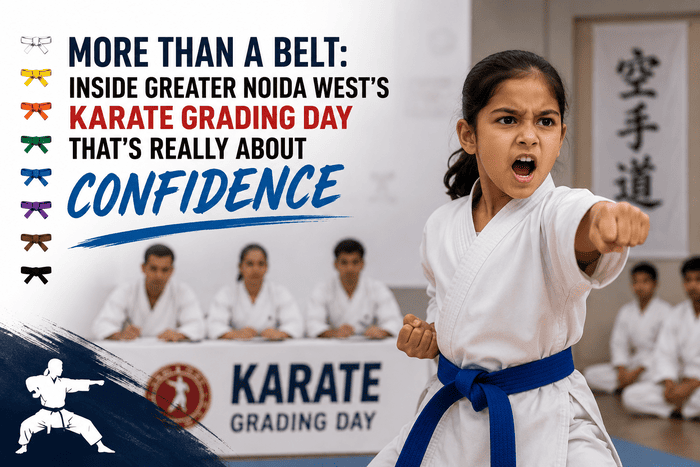
The morning of August 16, 2026, will look, on paper, like a routine sporting fixture: a belt grading examination, a school gymnasium, a panel of examiners with clipboards. But for the students lining up at Prominence World School in Knowledge Park V, it will feel like something closer to a rite of passage. Months of early-morning drills, bruised knuckles and repeated katas come down to a few minutes in front of judges who will decide whether they've earned the next colour around their waist.
The Karate Belt Grading Examination, organised by the Shitoryu Karate Association, Uttar Pradesh, is a familiar ritual in dojos across the state - but its significance rarely gets told from the student's side of the mat. Behind the formal certificates and belt colours lies a quieter story: of children learning to fall without fear, of teenagers finding a version of themselves they didn't know existed, and of a growing number of parents who now see karate not as an extracurricular add-on, but as something closer to a life skill.
What Actually Happens at a Belt Grading
For anyone who hasn't stood on a dojo floor, a belt grading can look deceptively simple — a student in a white gi bowing to an examiner, then moving through a sequence of strikes and blocks. In reality, it is closely structured, testing a hierarchy of skills built over months of practice.
Examiners at Uttar Pradesh's Shitoryu gradings typically assess candidates across several areas: Tsuki Waza (punching techniques), Geri Waza (kicking techniques), and Uke Waza (blocking and defensive techniques), alongside practical self-defence application. Two further disciplines carry particular weight - Kumite, or sparring, which tests a student's reflexes and composure under pressure, and Kata, the formal, choreographed patterns that karateka around the world use to demonstrate precision, balance and control.
This layered format mirrors the wider Kyu-Dan grading system used across most traditional karate styles in India, in which students typically progress through around ten to eleven coloured-belt ranks before qualifying to test for a black belt, or Shodan. According to the belt-grading framework published by Japan Karate-Do Shito-Ryu International in India, each examination is designed to evaluate not just technical execution but discipline, terminology, and conditioning - ensuring a student has genuinely internalised a level before being allowed to advance. It's a system built deliberately slow, on the theory that a rushed black belt is a hollow one.
For the students arriving at Prominence World School next month, that means the morning isn't really about a single performance. It's the visible tip of a much longer, less visible process - one built in early-morning practice sessions most people never see.
Why This Matters More For Girls Than the Syllabus Lets On
Read literally, a belt grading is about technique. Read in context, in Uttar Pradesh in 2026, it's about something larger.
Across India, karate and self-defence training for girls has moved from niche activity to near-mainstream expectation over the past decade, propelled in part by high-profile initiatives launched in the wake of well-publicised assault cases. The Women's Self Defence Centre, an initiative founded by actor Akshay Kumar and martial artist Mehul Vora in the aftermath of the 2012 Nirbhaya case, says it has now trained more than nine lakh women and girls free of cost across the country. Government-run programmes have followed a similar logic: under Samagra Shiksha's self-defence scheme in several states, girls from Class 6 to Class 12 in government schools now receive structured, months-long training in karate and allied disciplines as part of the regular curriculum, coordinated jointly by state education, women's welfare and sports departments.
Uttar Pradesh, and the Greater Noida region specifically, has seen its own version of this shift, with schools and colleges increasingly folding self-defence modules into student life rather than treating them as one-off workshops. The instinct driving it is consistent everywhere it appears: karate isn't only preparing girls to throw a punch if they ever need to. It's meant to change how they carry themselves before that moment ever arrives - how they walk, how they make eye contact, how quickly they can decide whether to run, shout, or stand their ground.
Instructors involved in similar programmes elsewhere in India describe a common turning point in training - the session where a participant, often for the first time, successfully blocks or repels an instructor's mock attack. What changes afterwards, they say, isn't just physical capability. It's posture. It's willingness to speak up. That is the quieter promise behind Saturday's grading in Knowledge Park V: for at least some of the students crossing the mat, the belt they earn will be a marker of something that has already happened inside them, not just a badge for what they can do with their fists.
The Physical and Mental Case for Karate
Strip away the philosophy, and the physical case for karate is straightforward. Regular practice builds cardiovascular endurance and full-body strength, while the emphasis on stances and controlled movement improves flexibility, balance and coordination in ways few conventional gym routines replicate. For children in particular, sparring and kata practice double as reflex training, sharpening the kind of quick, controlled reactions that carry over into other sports and everyday physical safety.
The mental case is less visible but, according to those who teach it, often more transformative. Kata demands total concentration - a single missed beat or misaligned stance is immediately obvious to a trained eye, which pushes students toward a discipline of attention that's hard to replicate in a classroom. Sparring, meanwhile, forces rapid decision-making under mild stress, a skill that transfers surprisingly well to exam pressure or public speaking. Instructors often describe visible changes in withdrawn or anxious students after a few months of training: steadier eye contact, a straighter back, a willingness to be first in line rather than last.
There's a social dimension too, one that can seem counterintuitive in an individual sport. Dojos function as small, tightly bonded communities, built around a shared vocabulary of respect - for instructors, for training partners, for the art itself - that many parents say is harder to instil through school alone. Belt progression, spaced out deliberately over months and years, quietly teaches patience in an era not exactly known for it.
For younger students, the reported benefits tend to cluster around focus and behaviour - better concentration in the classroom, reduced recreational screen time, and calmer responses to schoolyard bullying rather than escalation. For working adults who take up karate later in life, instructors report a different set of gains: stress relief after long workdays, improved posture from desk-bound routines, and a form of fitness that doesn't feel like the treadmill-and-repetition of a typical gym membership.
A Style With Deep Roots, Practised Far From Home
Shitoryu karate, the style at the centre of Saturday's grading, traces its lineage to Kenwa Mabuni, an early twentieth-century Okinawan master who fused elements of two older schools of Okinawan martial arts into a single, balanced system emphasising both hard, linear strikes and softer, circular defensive movement. Today it is practised globally under bodies including the World Shitoryu Karate Federation, itself affiliated with the World Karate Federation and recognised by the International Olympic Committee.
In Uttar Pradesh, the Shitoryu Karate Association describes itself as the state's principal affiliate of the All India Shitoryu Karate-do Union, additionally linked to the state's Karate Association of Uttar Pradesh and the Karate Welfare Association of Gautam Buddha Nagar — a layered structure of affiliations typical of how martial arts governance works in India, where state bodies answer upward through national federations to international ones.
That governance picture nationally has not been without turbulence. Karate has been without recognised National Sports Federation status from India's Ministry of Youth Affairs and Sports since 2020, after infighting led to the erstwhile Karate Association of India losing its world body affiliation; the Karate India Organisation was subsequently granted permanent affiliate status by the World Karate Federation in 2021. Even so, the Sports Authority of India has continued to back Indian karatekas through dedicated training camps ahead of major events including the 2026 Asian Games, and - crucially for Saturday's event - the disruption at the top of the sport's administration has done little to slow grassroots activity. Belt gradings, tournaments and dojo enrolments have continued largely uninterrupted at the state and district level, exactly the tier at which the Shitoryu Karate Association, Uttar Pradesh operates.
The People Presiding Over the Mat
Saturday's grading will carry the weight of both school and martial arts leadership. Prominence World School's Principal, Dr Mrinalini Singh, will attend as chief guest alongside Dr Anil Kaushik, a ninth-Dan black belt and senior figure within the karate fraternity - a rank that, under most traditional grading systems, sits near the very top of a lifetime's progression through the art.
They will be joined by the Shitoryu Karate Association's leadership: President Kyonshi Brij Mohan Khanna, Technical Director Shihan Kanhaiya Kumar, Treasurer Shihan Rajiv Mundelwal, Joint Secretary Shihan Jitendra Kumar, Technical Advisor Sensei Chandan Kumar, and General Secretary Shihan Vivek Kumar Srivastava. A team of coaches - Simran Rawat, Vivek Gupta, Akash Kumar, Mir Chauhan, Kuldeep Kumar, Harish Kumar, Aashi, Prince Khanna, Simran Khanna, Aman Kumar, Shahzad, Jonty Tomar, Yashika Chand and Aman - will run the examination itself, guiding students through each discipline as the panel assesses their progress.
Association officials have already extended their congratulations to the participating students ahead of the event, describing the grading as a marker of the bright futures they expect from the next generation of karateka passing through Uttar Pradesh's dojos.
What Comes Next
For most of the students grading on August 16, the day will end not with a trophy but with a new belt colour and a fresh syllabus to begin working on. That, instructors say, is rather the point - karate's reward structure is built for the long game, not a single afternoon. A handful may go on to district or state-level competition; a great many more will simply return to their dojo the following week and start again, a little further along a path that, for some, may eventually lead to a black belt years from now.
What the grading offers immediately, though, is a small, public acknowledgment of private effort - the kind that rarely gets celebrated outside a dojo. As karate continues its quiet expansion through schools across Greater Noida West and the wider National Capital Region, gradings like this one are becoming less of an anomaly and more of a fixture on the academic calendar, sitting alongside sports day and annual functions as another way schools measure a child's growth.
Key Facts at a Glance
Event | Karate Belt Grading Examination
Date | August 16, 2026
Venue | Prominence World School, Knowledge Park V, Greater Noida West
Organiser | Shitoryu Karate Association, Uttar Pradesh
Disciplines assessed | Tsuki Waza (punches), Geri Waza (kicks), Uke Waza (blocks), self-defence, Kumite (sparring), Kata (forms)
Chief guests | Dr Mrinalini Singh (Principal); Dr Anil Kaushik (9th Dan Black Belt)
Association leadership present | Kyonshi Brij Mohan Khanna, Shihan Kanhaiya Kumar, Shihan Rajiv Mundelwal, Shihan Jitendra Kumar, Sensei Chandan Kumar, Shihan Vivek Kumar Srivastava
Coaches conducting the exam | Simran Rawat, Vivek Gupta, Akash Kumar, Mir Chauhan, Kuldeep Kumar, Harish Kumar, Aashi, Prince Khanna, Simran Khanna, Aman Kumar, Shahzad, Jonty Tomar, Yashika Chand, Aman
Date | August 16, 2026
Venue | Prominence World School, Knowledge Park V, Greater Noida West
Organiser | Shitoryu Karate Association, Uttar Pradesh
Disciplines assessed | Tsuki Waza (punches), Geri Waza (kicks), Uke Waza (blocks), self-defence, Kumite (sparring), Kata (forms)
Chief guests | Dr Mrinalini Singh (Principal); Dr Anil Kaushik (9th Dan Black Belt)
Association leadership present | Kyonshi Brij Mohan Khanna, Shihan Kanhaiya Kumar, Shihan Rajiv Mundelwal, Shihan Jitendra Kumar, Sensei Chandan Kumar, Shihan Vivek Kumar Srivastava
Coaches conducting the exam | Simran Rawat, Vivek Gupta, Akash Kumar, Mir Chauhan, Kuldeep Kumar, Harish Kumar, Aashi, Prince Khanna, Simran Khanna, Aman Kumar, Shahzad, Jonty Tomar, Yashika Chand, Aman