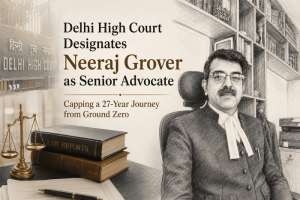
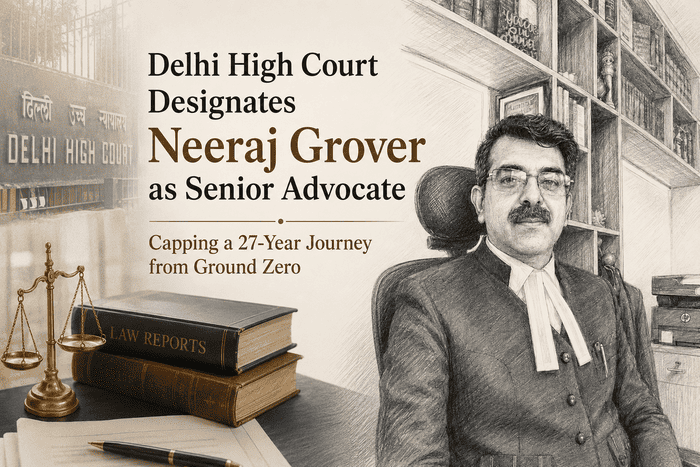
Neeraj Grover, a Delhi-based intellectual property litigator and registered patent agent who built his practice without the backing of a legal family or an established chamber, has been designated a Senior Advocate by the Delhi High Court, joining a list of 85 lawyers elevated by the Full Court in one of the largest such rounds in the court's six-decade history.
The designation was formalised through a notification dated July 9, 2026, issued by the Secretariat of the Committee for Designation of Senior Advocates, after the Full Court cleared the names at a meeting held the same evening. Grover, who has practised at the Delhi High Court bar for 27 years, announced the honour on LinkedIn, describing it as the outcome of "hard work, perseverance and belief" that had "finally paid off," and noting that he was joining the roll of designated Senior Advocates as a first-generation lawyer who started his career from scratch.
His elevation is notable for the scale of the exercise that produced it and for the personal weight he has attached to its timing - coming, by his own account, on the eve of his late father's birth anniversary.
A Rare, Large-Scale Elevation Round
The Delhi High Court's Full Court considered 231 applications for the 2026 round of Senior Advocate designations, a process in which the Committee for Designation of Senior Advocates first assesses and scores each candidate before placing recommendations before the full bench of judges for final approval. Of those 231 applicants, 85 were ultimately designated - a clearance rate of roughly 37 percent, reflecting how competitive and selective the process remains despite reforms intended to widen the field over the past decade.
The Committee that evaluated the 2026 batch was chaired by Chief Justice Devendra Kumar Upadhyaya and included Justices V. Kameswar Rao and Nitin Wasudeo Sambre, alongside the Delhi High Court Bar Association's president and representatives of the government's law officers. Eleven of the 85 newly designated Senior Advocates are women, among them Sangeeta Bharti, Abha Malhotra, Maneesha Dhir and Warisha Farasat.
Grover's name appears on the officially notified list alongside several other prominent Delhi-based practitioners, including Deepak Chopra, Shanker Raju, Satyakam and Pavan Duggal - names well known across the Delhi High Court's commercial, constitutional and intellectual property benches.
For context on scale: this round alone accounts for a meaningful share of all Senior Advocate designations the Delhi High Court has conferred since its establishment more than 60 years ago, a point Grover himself underscored in his public post, in which he said he considered it an "absolute honour" to join the ranks of 447 advocates designated as Senior Advocates by the court across its entire history.
What the Designation Actually Means
Under Section 16(2) of the Advocates Act, 1961, the Supreme Court and every High Court in India are empowered to designate an advocate as a Senior Advocate if the court is of the opinion that the individual's ability, standing at the bar, or specialised knowledge and experience in law merits the distinction - provided the advocate consents to being so designated.
The designation is not merely honorific. Senior Advocates operate under a distinct set of professional restrictions and privileges: they cannot draft pleadings, file vakalatnamas, or accept instructions to appear in court directly from clients, and must instead be briefed by another advocate acting alongside them. In courtroom convention, their gowns carry a distinguishing flap - a visible marker, alongside the title itself, of a lawyer regarded as having reached the upper tier of courtroom advocacy.
The process by which advocates are designated has itself been the subject of sustained legal reform over the past decade. A 2015 petition filed by Senior Advocate Indira Jaising challenged the historically opaque and discretionary nature of the designation process, arguing it was prone to bias and favouritism. The Supreme Court's landmark 2017 ruling in that case introduced a standing, committee-based evaluation framework, later revised through further guidelines in 2018 and 2023 that moved toward a points-based assessment weighing courtroom performance, reported judgments and years of standing at the bar more heavily than earlier criteria.
Delhi High Court's own procedural framework for 2026 designations operates under rules framed in 2024 pursuant to those Supreme Court directions - meaning Grover's designation was assessed under one of the more structured and scrutinised versions of the process the Indian judiciary has used to confer the title.
Legal commentators continue to debate whether the reforms have gone far enough. Data cited in legal-affairs commentary shows persistent underrepresentation of certain communities among Senior Advocates historically, and critics - including Jaising herself - have pointed to the continuing influence of established chambers and family legal networks in shaping outcomes. Against that backdrop, first-generation lawyers who reach the designation without such institutional backing are frequently highlighted within the legal fraternity as evidence that the post-2017 framework is, at least incrementally, opening the field.
From Campus Law Centre to Independent Chambers
Grover's professional path traces a fairly linear arc through Delhi's legal and intellectual property ecosystem. He was enrolled with the Bar Council of Delhi in 1999 after completing his law degree at Campus Law Centre, University of Delhi - a timeline that aligns with the 27 years of practice he referenced in his own announcement.
Over more than two decades, Grover built a practice centred on intellectual property litigation - trademarks, copyrights, patents and designs - while also appearing in civil and criminal matters, including white-collar and economic offence cases, arbitration references, writ petitions and consumer disputes. He is additionally a Registered Patent Agent with India's Office of the Controller of Patents, a technical qualification that sits alongside his litigation practice and is relatively uncommon among courtroom advocates who typically specialise in either prosecution work or contentious litigation, but rarely both.
Publicly available professional records show Grover spent time as Head of Intellectual Property and a litigation partner at Kochhar & Co., a Delhi-headquartered law firm, between 2013 and 2017, before establishing his own independent chambers later that year. He has also served as an of-counsel consultant to Zeus IP, a boutique intellectual property firm, earlier in his career. Since 2017, he has practised as an independent arguing counsel, frequently briefed by other law firms and advocates to argue matters before the Delhi High Court and other constitutional courts - a professional arrangement common among specialist litigators who build a reputation for courtroom advocacy in a narrow field of law.
Grover has also trained as a mediator with SAMADHAN, the Delhi High Court's Mediation and Conciliation Centre, and has been listed among its empanelled mediators handling court-referred disputes in recent case rosters - an additional strand to a practice that has combined adversarial litigation with alternative dispute resolution work.
Industry recognitions cited in his professional profile include being named a Recommended Lawyer by the Legal 500 directory and a Leading Lawyer by Asia Law, two of the rankings frequently used within the Indian legal industry to benchmark practitioners in specialist fields such as intellectual property.
The Personal Note: A Tribute to His Father
What distinguishes Grover's announcement from a standard professional milestone post is the personal framing he gave it. In his LinkedIn statement, Grover said the timing of his designation - arriving close to what would have been his father's birth anniversary - carried particular significance, describing his father as someone who had long wished to see him "wearing the coveted Senior Jacket" but who passed away in 2023 before that could happen.
He addressed his father directly in the post, saying he hoped his father was, in his words, watching and "feeling proud" of him. Grover also thanked the judges of the Delhi High Court and other courts where he has practised over 27 years, along with the briefing counsels who continued to engage his services as an arguing counsel through the years before his designation. He extended a further note of gratitude to his wife and children, acknowledging what he described as the time his professional commitments had taken away from family life.
Such personal tributes accompanying professional designations are common within India's legal community, where achieving Senior Advocate status is often treated as a career-defining milestone worthy of public acknowledgment - not just of the advocate's own effort, but of the family, mentors, and judges who shaped the path to it.