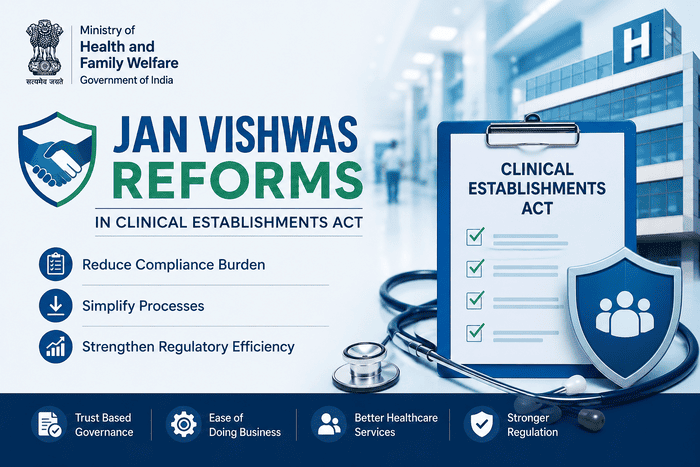
The Union Ministry of Health and Family Welfare has notified landmark amendments to the Clinical Establishments (Registration and Regulation) Act, 2010, effective June 22, 2026 — a move that fundamentally shifts how India regulates its hospitals, clinics, and diagnostic centres. The changes, enacted under the Jan Vishwas (Amendment of Provisions) Act, 2026, replace criminal penalties for procedural lapses with structured administrative sanctions, marking a decisive turn toward trust-based governance in the healthcare sector.
From Courtrooms to Adjudication Rooms
The most significant change is the replacement of the word "fine" with "penalty" across Sections 40, 43, and 46 of the Act. This is not mere semantics. The shift moves the enforcement framework from criminal prosecution to administrative adjudication, meaning that a clinic found in procedural non-compliance will now face a designated adjudicating officer — not a criminal court judge. Under the earlier framework, clinical establishments could face criminal prosecution for minor deficiencies that could have been easily rectified. The reform replaces this with a civil penalty of up to ₹10,000.
Section 44 introduces graded penalties for companies, calibrated to the nature and severity of the violation — a departure from the one-size-fits-all criminal approach. The adjudicating authority under Section 41 has been expanded to cover proceedings under Sections 40, 43, and 44, creating a unified, accountable enforcement mechanism.
Part of a Sweeping National Reform
This notification is one piece of a far larger legislative overhaul. The Jan Vishwas (Amendment of Provisions) Act, 2026 has been passed by both Houses of Parliament and amends 784 provisions across 79 Central Acts administered by 23 Ministries — of which 717 provisions have been decriminalized to promote Ease of Doing Business, while 67 target Ease of Living.
Within health alone, 35 provisions across five Acts under the Ministry of Health and Family Welfare have been amended, including the Drugs and Cosmetics Act, 1940; the Pharmacy Act, 1948; the Food Safety and Standards Act, 2006; the Clinical Establishments Act, 2010; and the National Commission for Allied and Healthcare Professions Act, 2021.
Due Process Now Built In
The amendments also install procedural safeguards: healthcare providers must be given an opportunity to be heard before any penalty is imposed. Mechanisms for penalty recovery and an appeal framework for aggrieved parties are now codified. Minor compliance issues can now be resolved through designated officers rather than criminal courts, reducing litigation time and legal costs for healthcare businesses.
The reforms implement recommendations of the High-Level Committee on Regulatory Reforms and build on the foundation laid by the original Jan Vishwas Act of 2023, which had decriminalized 183 provisions across 42 Central Acts.
--------------------------------------------------
Below is the press release by PIB
--------------------------------------------------
Five provisions under the Clinical Establishments Act, 2010 rationalized under Jan Vishwas reforms
--------------------------------------------------
Five provisions under the Clinical Establishments Act, 2010 rationalized under Jan Vishwas reforms
Union Ministry of Health and Family Welfare has notified amendments to the Clinical Establishments (Registration and Regulation) Act, 2010 on 22 June 2026 in pursuance of the Jan Vishwas (Amendment of Provisions) Act, 2026, which was published in the Official Gazette on 8 April 2026. The reforms are aimed at promoting trust-based governance, reducing compliance burden, improving ease of doing business, and ensuring proportionate regulatory enforcement, while continuing to safeguard patient safety and the quality of healthcare services across the country.
The Jan Vishwas (Amendment of Provisions) Act, 2026 rationalizes provisions across 79 Central Acts administered by 23 Ministries and Departments. In the health sector, 35 provisions across five Acts under the Ministry of Health and Family Welfare have been amended to decriminalize minor procedural non-compliances and strengthen citizen-centric regulatory practices. The amendments notified under the Clinical Establishments Act, 2010 form part of this broader reform initiative aimed at creating a more responsive and facilitative regulatory ecosystem.
Under the amended framework, the term “fine” has been replaced with “penalty” in Sections 40, 43 and 46 of the Act, thereby shifting the enforcement framework from criminal prosecution to administrative adjudication. Section 44 has been amended to introduce graded and proportionate penalties for contraventions committed by companies, ensuring that enforcement action is commensurate with the nature and severity of the violation. Further, the adjudicating authority mechanism under Section 41 has been strengthened and its scope expanded to cover proceedings under Sections 40, 43 and 44, thereby facilitating transparent, efficient and accountable enforcement.
The amendments also provide for a structured adjudication process, including an opportunity of hearing before the imposition of penalties, mechanisms for recovery of penalties, and an appeal framework for aggrieved parties. These measures are expected to encourage voluntary compliance, reduce unnecessary litigation, and ensure proportionate action in cases of minor procedural non-compliances, while maintaining regulatory oversight over clinical establishments.
The notification implements the recommendations of the High-Level Committee on Regulatory Reforms and underscores the Government’s commitment to fostering a transparent, efficient and citizen-centric regulatory framework. By replacing criminal penalties for procedural lapses with a fair and balanced administrative mechanism, the reforms seek to improve the ease of doing business in the healthcare sector while preserving the highest standards of patient care, safety and accountability.
------------------------------------------
Link to PIB: https://pib.gov.in/PressReleaseIframePage.aspx?PRID=2277693