India Lifts Emergency Fuel Restrictions From July 1 as Supply Crisis Eases
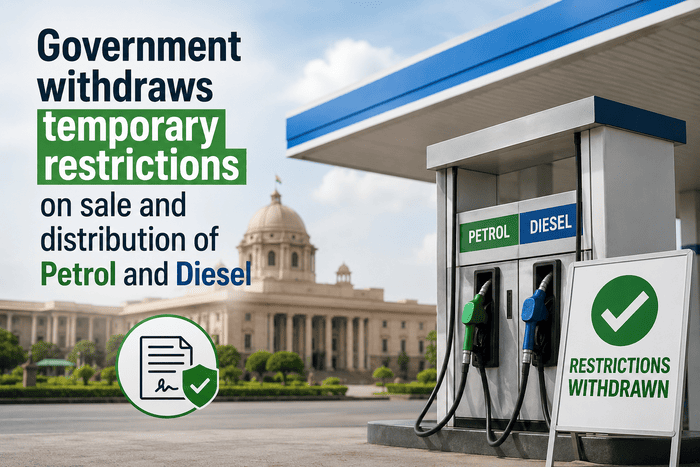
Government withdraws diesel purchase caps and bulk buyer ban introduced amid West Asia conflict
Emergency Order Scrapped Ahead of Schedule
The restrictions, introduced on June 12, 2026, had capped diesel purchases at 200 litres per customer or vehicle per day and barred industrial, commercial, and institutional consumers from buying fuel at retail pumps run by state-owned oil marketing companies (OMCs). Violations were punishable under the Essential Commodities Act, 1955. The order had been issued for an initial period of up to 90 days - making its withdrawal in under three weeks a significant and early reversal.
What Triggered the Curbs
The crisis did not begin with a shortage - it began with a pricing gap. After the West Asia conflict escalated in late February 2026, state-owned OMCs held retail pump prices below cost to protect ordinary consumers from global price shocks, while bulk pricing continued tracking market rates.
Diesel at retail pumps was priced at ₹95.20 per litre in Delhi, while bulk sales were priced at ₹134.50 - a gap that incentivised large industrial, commercial, and institutional users to begin procuring fuel through retail stations instead of their designated bulk supply points. This caused abnormal demand surges in several pockets and raised fears of localised shortages.
The government said public sector OMCs - Indian Oil Corporation, Bharat Petroleum Corporation, and Hindustan Petroleum Corporation - were absorbing losses of nearly ₹500 crore per day on the sale of petrol, diesel, and domestic LPG to shield consumers from the impact of the West Asia crisis.
Normal Supply Restored
The government has now concluded that the supply situation has sufficiently stabilised to render the emergency measures unnecessary. By lifting these temporary curbs, the government has signalled that domestic fuel inventories have fully stabilised and the emergency intervention is no longer required to ensure equitable distribution, prevent hoarding, or maintain fair market prices.
The Ministry stated that the temporary measures successfully ensured adequate and uninterrupted fuel availability for retail consumers throughout the period of disruption.
What Changes From July 1
From July 1, industrial, commercial, and institutional consumers may once again purchase petrol and diesel at public sector retail outlets without restriction. The 200-litre daily cap on diesel stands withdrawn. Normal procurement arrangements stand fully restored.
The three major state-run OMCs - Indian Oil Corporation, Bharat Petroleum Corporation, and Hindustan Petroleum Corporation - collectively operate roughly 90% of India's 100,000-plus fuel stations and will return to standard operations from the start of the new month.
The swift rollback is being read as a signal of easing pressure on India's domestic fuel supply chain following weeks of global energy market volatility driven by the West Asia conflict.
----------------------------------------
Below is the press release by PIB
----------------------------------------
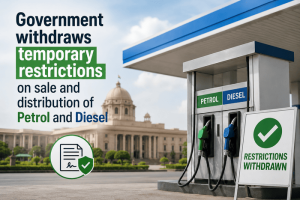
The Ministry of Petroleum and Natural Gas has withdrawn the temporary regulatory measures governing the sale and distribution of Motor Spirit (MS) and High Speed Diesel (HSD) through retail outlets of Public Sector Oil Marketing Companies with effect from 1st July, 2026.
During the period of disruptions arising from the West Asia crisis, the Government continued to shield retail consumers from the sharp increase in international fuel prices by maintaining stable retail prices of petrol and diesel. This led to a significant price difference between retail fuel prices and those applicable to bulk consumers. Consequently, certain industrial, commercial and institutional consumers began procuring fuel through retail outlets, leading to instances of diversion, hoarding and black marketing, which affected the equitable distribution of fuel.
To address this situation, the temporary regulatory measures, introduced on 12th June, 2026, prescribed a temporary limit of 200 litres of High Speed Diesel (HSD) per customer/vehicle per day at retail outlets and required industrial, institutional and commercial consumers to procure fuel through designated consumer pumps instead of retail outlets. The measures were aimed at preventing black marketing, hoarding and diversion of diesel while ensuring uninterrupted availability of petrol and diesel to retail consumers.
Following a review of the supply situation of petroleum products in the country, the Government has concluded that the temporary regulatory measures are no longer required in the public interest. Accordingly, the Order dated 12th June, 2026 stands withdrawn with effect from 1st July, 2026.
The temporary measures helped ensure adequate availability of petrol and diesel across the country while safeguarding the interests of retail consumers. Their withdrawal reflects the improvement in the supply situation and the restoration of normal supply arrangements.
----------------------------
Link to PIB: https://www.pib.gov.in/PressReleaseIframePage.aspx?PRID=2279131®=48&lang=2
----------------------------
Link to PIB: https://www.pib.gov.in/PressReleaseIframePage.aspx?PRID=2279131®=48&lang=2