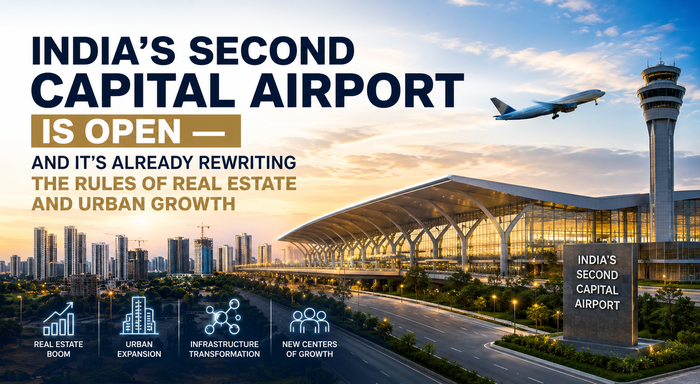
For a project that spent years with postponed deadlines, Noida International Airport arrived on the scene with remarkable quiet. There was no gridlock on the Yamuna Expressway. No chaotic ribbon-cutting scrum. Just an Airbus, landed at 8:05 AM on June 15, touching down at a brand-new runway 72 kilometres southeast of Delhi — and with it, a decade of ambition finally, irreversibly, became real.
India’s newest greenfield airport is open. And the questions that follow are far bigger than any single flight.
From Foundation Stone to First Flight
From Foundation Stone to First Flight
To understand what June 15, 2026, truly means, it helps to know how many times the aviation world was told this day had already arrived.
Prime Minister Narendra Modi first laid the foundation stone at Jewar on November 25, 2021, with the government’s target firmly fixed on September 2024 for the first commercial operations. That date slipped. Then came October 2025, followed by December 2025 assurance that the airport would open “next month” in January 2026.
What finally broke the cycle was not political pressure but paperwork — the right kind. On March 6, 2026, the Directorate General of Civil Aviation (DGCA) granted the Aerodrome Licence to Yamuna International Airport Private Limited (YIAPL), clearing the airport for all-weather, public-use commercial operations. Three weeks later, on March 28, Prime Minister Modi inaugurated Phase 1 of the Noida International Airport at Jewar — and this time, an actual opening date followed: June 15, 2026.
The wait, was over.
What finally broke the cycle was not political pressure but paperwork — the right kind. On March 6, 2026, the Directorate General of Civil Aviation (DGCA) granted the Aerodrome Licence to Yamuna International Airport Private Limited (YIAPL), clearing the airport for all-weather, public-use commercial operations. Three weeks later, on March 28, Prime Minister Modi inaugurated Phase 1 of the Noida International Airport at Jewar — and this time, an actual opening date followed: June 15, 2026.
The wait, was over.
What Is Noida International Airport — And Why Does It Matter So Much?
The short answer: it is the second major international airport serving the Delhi-NCR region, and the first greenfield airport in India to be built to this scale and specification in the 21st century.
The longer answer is more consequential.
Noida International Airport sits in Jewar, Gautam Buddha Nagar district, Uttar Pradesh — roughly 72 kilometres from central Delhi, connected directly by the signal-free Yamuna Expressway. It is operated by YIAPL, a subsidiary of Switzerland’s Zurich Airport International AG, under a public-private partnership model.
Phase 1 capacity: 12 million passengers per annum. When all four phases are complete — the master plan projects a horizon of 2040 and beyond — the airport will handle 70 million passengers annually across multiple runways.
At full build-out, it is designed to become one of the largest aviation hubs in Asia.
June 15: What Actually Happened on Day One
The first commercial flight to touch down at DXN was an IndiGo service from Lucknow, arriving at 8:05 AM. It then departed as the airport’s first outbound service, bound for Bengaluru — a route that would have previously required passengers from eastern Noida to brave a 90-minute drive to IGI before even reaching the departures hall.
IndiGo, India’s largest airline by market share, is the airport’s launch carrier. At opening, it announced plans to connect Noida International Airport with more than 16 cities across the country, including Bengaluru, Hyderabad, Amritsar, Chandigarh, Dharamshala, Jaipur, Lucknow, Navi Mumbai, Pantnagar, and Srinagar.
A day later, on June 16, Akasa Air began its own operations from DXN, adding daily services to Bengaluru and Navi Mumbai. Air India Express is confirmed for the network shortly after launch.
The Airport Itself: Design, Technology, and the UP Identity Built Into Every Wall
Terminal 1 at Noida International Airport is not simply a functional building. It is a deliberate cultural statement.
Designers have drawn from Uttar Pradesh’s ghats — the iconic river-step architectures of Varanasi and Prayagraj — and woven references to the state’s river heritage into the terminal’s spatial language. Travellers passing through DXN are, architecturally speaking, moving through a reimagined landscape of the region they are departing from or arriving into.
The technology embedded in the facility is equally forward-thinking. The terminal features face-recognition-based boarding at all entry gates, eliminating the need for physical boarding passes. Security processing, baggage handling, and passenger flow systems have been designed with efficiency standards comparable to top-tier international hubs.
The airport has been built to function as a net-zero emissions facility, integrating energy-efficient systems across its operations — a distinction that makes it one of the greenest aviation infrastructure projects commissioned in India to date.
CAT III-B runway certification is not a cosmetic detail. During Delhi-NCR winters, dense fog routinely drops visibility at IGI below operational minimums, causing mass diversions and cancellations. DXN’s runway is certified for operations in precisely those conditions.
The Crore's Question: Who Built This and How?
Noida International Airport is a greenfield project executed under the public-private partnership model, with YIAPL — a subsidiary of Zurich Airport International AG — as the concessionaire. Zurich Airport brings operational expertise from one of Europe’s most highly rated airport experiences.
The airport is developed in partnership with the Yamuna Expressway Industrial Development Authority (YEIDA), with the Government of Uttar Pradesh as the nodal state authority and the Ministry of Civil Aviation providing the regulatory framework.
The Real Disruption: What DXN Does to Delhi’s Aviation Geography
Delhi’s Indira Gandhi International Airport has long operated under mounting pressure. Serving the capital of the world’s most populous country and one of its fastest-growing aviation markets, IGI regularly handles passenger volumes that strain its infrastructure.
Noida International Airport is designed in part to absorb that pressure — specifically serving the eastern and southeastern belt of NCR, a zone that includes Noida, Greater Noida, Ghaziabad, Faridabad, and Western Uttar Pradesh, regions that collectively account for tens of millions of residents.
The time-saving arithmetic is stark. A traveller from Greater Noida heading to IGI faces a minimum 90-minute commute through dense urban traffic. The same traveller can reach DXN via the Yamuna Expressway in under 30 minutes.
For millions of daily travellers across the NCR’s eastern corridor, the “airport run” has fundamentally changed.
Jobs, Industry, and the Aerotropolis Dream
Beyond the terminal gates lies what may be the airport’s most economically transformative dimension: the aerotropolis concept baked into YEIDA’s Master Plan 2041.
An aerotropolis is not merely an airport with adjacent amenities. It is an integrated urban-economic ecosystem — commercial zones, logistics parks, industrial clusters, hospitality districts, and residential neighbourhoods — all built around aviation connectivity as their core organising principle. Think of what Gurgaon became relative to Delhi, and multiply it by a runway.
The Jewar corridor is already seeing this model take shape. YIAPL and NIAL project shaping 1000s of direct jobs in early-stage operations alone, will be adding more direct jobs within five years and in the long term.
Around the airport, the following developments are either planned or underway: a Noida International Film City, a semiconductor park, Electronic City, a medical device park, a Central Business District, and an Olympic Park.
Connectivity infrastructure includes a planned metro link to Greater Noida and central Delhi, a Regional Rapid Transit System (RRTS) corridor from Delhi to Jewar, a dedicated road corridor to the Delhi-Mumbai Expressway via Faridabad, and a pod taxi link connecting the airport to Noida Film City across 12 stations.
Real Estate: The Surge That Started Before the First Flight
Property markets, unlike aviation schedules, did not wait for the airport to open.
Residential property values along the Yamuna Expressway corridor have already recorded appreciation in the range of 40–80% over the past several years, with some micro-markets reporting increases well above that range. Current residential rates in the region typically run between ₹8,000 and ₹12,000 per square foot. Noida overall is reported to be up 92% and Greater Noida up 98% from Q1 2020 to Q1 2025 in tracked residential indices.
Experts caution, however, that this is not a one-time spike but the beginning of a structural growth cycle. Zones along the Yamuna Expressway, Greater Noida West, Jewar itself, and sectors near planned metro routes are expected to see the most sustained appreciation.
The Larger Story: What Jewar Tells Us About India’s Aviation Ambition
India is the world’s third-largest domestic aviation market. By most credible projections, it will be the third-largest overall aviation market globally within the next decade.
If DXN can attract airlines, grow its route network, integrate smoothly with the NCR transport grid, and catalyse the aerotropolis ecosystem around Jewar, it becomes a template. A template for how India builds greenfield airports, develops PPP-model aviation infrastructure, and connects its cities through purpose-built hub facilities.
The first flight has landed. The first passengers have departed. The first real test has barely begun.
Noida International Airport is the biggest aviation infrastructure story in India right now — and it is only just beginning.