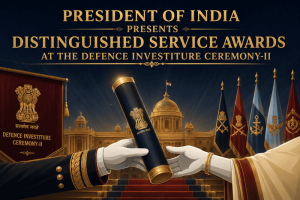
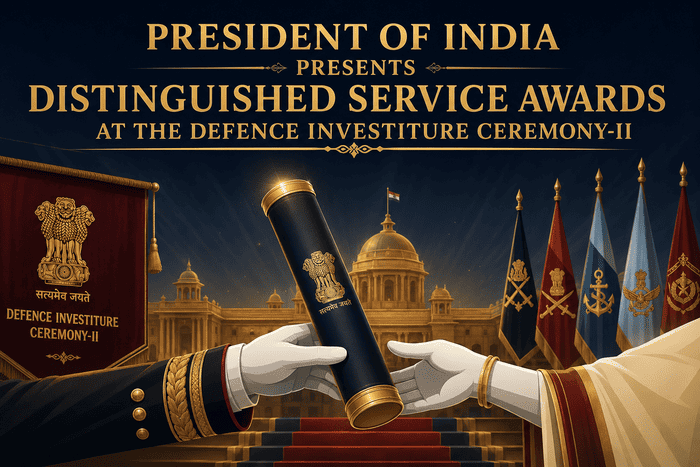
President Droupadi Murmu presented Distinguished Service Awards at the Defence Investiture Ceremony-II at Rashtrapati Bhavan on June 29, 2026, conferring the Ati Vishisht Seva Medal, Uttam Yudh Seva Medal, Param Vishisht Seva Medal and Sarvottam Yudh Seva Medal on senior officers across the Armed Forces. Vice President Jagdeep Dhankhar and Defence Minister Rajnath Singh were among the dignitaries present. On the surface, this is a ceremonial formality. Read more closely, it is a window into how India institutionalises command, continuity and strategic judgment alongside the battlefield bravery that usually dominates headlines.
A Tale of Two Ceremonies
The phase-II event completed a two-part cycle that began three weeks earlier. On June 8, President Murmu had conferred 51 gallantry awards — seven Kirti Chakras, 15 Vir Chakras and 29 Shaurya Chakras - on personnel of the Armed Forces, Central Armed Police Forces and State and Union Territory Police, including two Kirti Chakras, three Vir Chakras and one Shaurya Chakra awarded posthumously. Those Phase-I honours recognised split-second acts of courage: Lieutenant Shashank Tiwari's Kirti Chakra (Posthumous) for sacrificing his life rescuing a fellow soldier from a raging river in North Sikkim, and Major Ashish Kumar's Shaurya Chakra for a counter-terrorist operation in Anantnag that eliminated a high-value operative.
Phase-II, by contrast, honoured a different kind of contribution. President Murmu presented the Param Vishisht Seva Medal to Air Marshal Ashutosh Dixit, the Uttam Yudh Seva Medal to Lt Gen Dhiraj Seth, and the Sena Medal to Major General Mandeep Singh. Admiral Krishna Swaminathan, who took over as the 27th Chief of the Naval Staff on May 31, 2026, was awarded the Param Vishisht Seva Medal in recognition of his distinguished and exceptional service, having previously served as Flag Officer Commanding-in-Chief of the Western Naval Command and the 46th Vice Chief of the Naval Staff. Notably, women officers featured prominently: Surgeon Vice Admiral Kavita Sahai (Retd.), who concluded her career as Director General Medical Services (Navy), became the eighth woman in the Indian Armed Forces to reach three-star rank, while Surgeon Vice Admiral Arti Sarin, the first woman to lead the tri-service medical organisation and the highest-ranking female officer in Indian military history, received the Ati Vishisht Seva Medal.
Why the Distinction Matters
This split between gallantry and distinguished service is not bureaucratic redundancy; it reflects a deliberate institutional philosophy. As one defence commentary noted, these medals reward the burden of command and the strategic impact that only comes with senior rank, and wars are not won by heroics alone — planning, logistics, intelligence and leadership win them, with a poor strategic decision capable of costing more lives than enemy fire. The same analysis observed that the Param Vishisht Seva Medal is reserved for Lieutenant Generals, Vice Admirals and Air Marshals, and recognises sustained, exceptional service and command responsibility rather than combat valour.
Historically, this dual structure traces back to a 1967 reorganisation. Until January 27, 1967, the two lower peacetime gallantry decorations and the two higher peacetime distinguished service medals had been distinct classes of the Ashoka Chakra and the Vishisht Seva Medal respectively, before being separated into the system recognisable today. The Param Vishisht Seva Medal, established in 1960, recognises senior officers who have demonstrated outstanding leadership and exemplary service over an extended period, with recipients often holding key command or staff positions that reflect significant contributions to national security.
Reading the Wider Pattern
Seen together, the two phases of the 2026 Defence Investiture Ceremony map onto a broader institutional logic: frontline courage and senior command judgment are treated as complementary, not competing, pillars of security. The gallantry awards skewed toward operational theatres — counter-terrorism in Jammu & Kashmir, insurgency response in Manipur's Jiribam district, and counter-infiltration along the Indo-Myanmar border — while the Distinguished Service Medals recognised officers whose impact is measured in decades of command rather than single missions, including a serving Navy chief, an incoming Army chief and the medical leadership of two services.
This is consistent with past cycles. On the eve of the 79th Independence Day in 2025, President Murmu approved 127 Gallantry awards and 40 Distinguished Service awards together, underscoring that India's honours architecture is built around this twin recognition each year, not as an afterthought but as policy. For an institution whose effectiveness depends on both the soldier under fire and the officer planning years ahead, the symbolism of awarding both - separately, deliberately, twice a year - is itself a statement about how national security is actually built.
----------------------------------------
Below is the press release by PIB
----------------------------------------
The President of India, Smt Droupadi Murmu presented Distinguished Service Awards (Ati Vishisht Seva Medals, Uttam Yudh Seva Medals, Param Vishisht Seva Medals and Sarvottam Yudh Seva Medals) at the Defence Investiture Ceremony-II held at Rashtrapati Bhavan today (June 29, 2026).
Among the dignitaries present on the occasion were the Vice President of India and Union Minister of Defence.
----------------------------
Link to PIB: https://www.pib.gov.in/PressReleaseIframePage.aspx?PRID=2279172®=48&lang=2
Link to PIB: https://www.pib.gov.in/PressReleaseIframePage.aspx?PRID=2279172®=48&lang=2