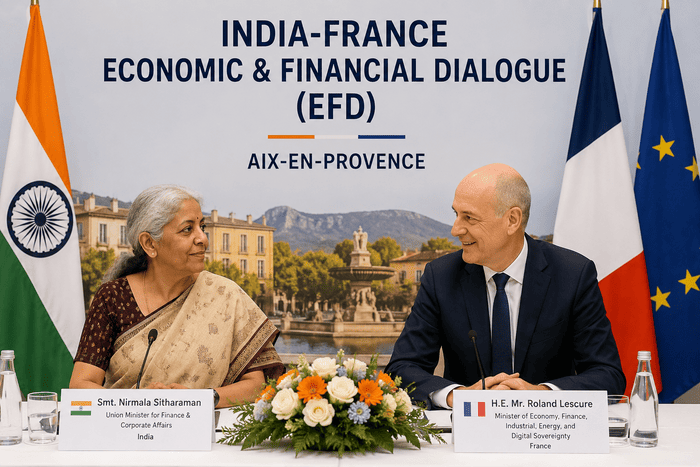
India and France on Friday revived one of the oldest institutional channels in their bilateral relationship, with Union Finance Minister Smt. Nirmala Sitharaman and French Minister of Economy, Finance, Industrial, Energy, and Digital Sovereignty H.E. Mr. Roland Lescure co-chairing the India-France Economic and Financial Dialogue (EFD) in Aix-en-Provence. The meeting, held against the backdrop of a fast-deepening special global strategic partnership between the two countries, produced commitments on critical minerals cooperation, cross-border investment, high-speed rail collaboration, and closer coordination within multilateral economic institutions such as the G20 and the Paris Club.
The dialogue, according to an official statement, was framed as a necessary next step given how far the India-France economic relationship has progressed in recent years. As the economic relationship between India and France deepens within the broader framework of the special global strategic partnership, resuming high-level exchanges on international outlook, bilateral cooperation and outcome-oriented solutions had become essential, the statement said.
Key Facts at a Glance
DetailInformationEvent | India-France Economic and Financial Dialogue (EFD)
Location | Aix-en-Provence, France
Date | July 3, 2026
Co-Chairs | Smt. Nirmala Sitharaman (India) and H.E. Mr. Roland Lescure (France)
Origin of commitment | Pledged during President Macron's India visit, February 2026
Key themes | G20/Paris Club alignment, critical minerals, high-speed rail, cross-investment, financial sector connectivity
Next dialogue | Proposed for 2027
Location | Aix-en-Provence, France
Date | July 3, 2026
Co-Chairs | Smt. Nirmala Sitharaman (India) and H.E. Mr. Roland Lescure (France)
Origin of commitment | Pledged during President Macron's India visit, February 2026
Key themes | G20/Paris Club alignment, critical minerals, high-speed rail, cross-investment, financial sector connectivity
Next dialogue | Proposed for 2027
A Dialogue Rooted in a Leaders-Level Commitment
The Aix-en-Provence meeting did not emerge in isolation. It traces directly back to February 2026, when French President Emmanuel Macron travelled to Mumbai for his fourth official visit to India, co-chairing the AI Impact Summit with Prime Minister Narendra Modi and jointly inaugurating the India-France Year of Innovation. During that visit, the two leaders elevated the relationship to a "Special Global Strategic Partnership," and, as part of the accompanying roadmap, Prime Minister Modi committed to holding the Economic and Financial Dialogue within the year - a commitment now fulfilled with Friday's meeting.
The EFD itself is not a new mechanism; it has functioned intermittently as one of several institutional pillars supporting the broader relationship, alongside the Strategic Dialogue between national security advisers, the annual Defence Dialogue, and, more recently, an annual Foreign Ministers' Comprehensive Dialogue established in February 2026 to track implementation of the "Horizon 2047" roadmap - a document that charts the relationship through 2047, the year that will mark a century of Indian independence and fifty years of the strategic partnership.
What distinguishes this year's edition is the explicit framing around resumption. Officials on both sides characterised high-level economic exchanges as having lapsed in intensity even as political and technological cooperation accelerated - through the AI Action Summit in Paris in February 2025, the AI Impact Summit in India in February 2026, and a steady cadence of ministerial visits. The EFD's revival is intended to correct that imbalance, positioning finance and economic policy coordination on equal footing with the more visible technology and strategic-cooperation tracks.
Aligning Positions Ahead of France's G7 Presidency
A significant portion of Friday's discussion centred on multilateral coordination. The two sides discussed greater alignment of their positions within multilateral economic platforms such as the G20 and the Paris Club, in the context of India's association with the French G7 presidency, with both ministers also exchanging views on the world economic outlook.
France assumed the G7 presidency for 2026, and Macron formally invited Modi during the February visit to participate in the G7 Summit and in preparatory discussions ahead of it, particularly on questions of global macroeconomic imbalances. India, while not a G7 member, has increasingly been drawn into the group's deliberations as an invited partner - a pattern consistent with recent summits, where New Delhi has pushed for reforms to development financing, more resilient global supply chains, and a more balanced international economic order. Friday's conversation on the Paris Club - the informal group of creditor nations that coordinates sovereign debt restructuring - suggests India and France are also seeking common ground on debt-related questions affecting developing economies, an area where the two countries have not always shared identical positions in the past.
For India, alignment with the French G7 agenda offers a channel to shape conversations on economic security and macroeconomic stability without the obligations of formal membership. For France, India's participation lends weight to G7 outreach efforts at a moment when the group is under pressure to demonstrate relevance to the Global South.
Critical Minerals Take Centre Stage
Among the most consequential outcomes flagged from the dialogue was the discussion on critical minerals. Potential areas for greater bilateral cooperation were discussed, including the roll-out of India-France cooperation on critical minerals, as part of a wider conversation between the two countries on policies towards economic sovereignty and security, as well as ways to increase cross-investments.
Critical minerals - lithium, cobalt, rare earth elements, and other inputs essential to batteries, semiconductors, and clean-energy technologies - have become a central pillar of economic-security policy for both nations. India has been working to diversify its mineral supply chains away from overwhelming dependence on a small number of countries, while France, through initiatives tied to the European Union's Critical Raw Materials Act, has been pursuing similar diversification for European industry. The two countries' interest in linking these efforts reflects a broader pattern visible across the India-France relationship over the past two years: economic cooperation is increasingly being discussed not in isolated commercial terms, but as part of a shared vocabulary around "economic sovereignty and security" - language that has entered the bilateral lexicon alongside discussions on semiconductors, defence manufacturing, and digital infrastructure.
The framing suggests that critical minerals cooperation, still described as being at a "roll-out" stage, will likely translate into more concrete agreements - potentially covering exploration, processing technology transfer, or joint investment vehicles - ahead of or during the next edition of the dialogue.
Institutionalising the Relationship
Perhaps the most structurally significant outcome from Aix-en-Provence was procedural rather than substantive: the two ministers agreed to institutionalise the EFD as a recurring mechanism. The ministers pledged to use the Economic and Financial Dialogue as the main platform for addressing economic, financial, technological, investment and trade matters between India and France, and agreed to explore holding the next edition in 2027.
This commitment to regularity matters. Much of the India-France relationship over the past three years has been driven by leaders' summits and high-profile technology showcases — the AI Action Summit, the AI Impact Summit, the Year of Innovation - that generate momentum but do not always translate into sustained institutional follow-through on economic policy specifics. By designating the EFD as the "main platform" for economic and financial matters, the two governments appear to be signalling an intent to give finance ministries a standing seat at the table, distinct from the more visible strategic and technology-focused tracks led by national security advisers and heads of state.
What Comes Next
Officials gave no detailed timeline for translating Friday's discussions into binding agreements, and much of the language used — "potential areas," "proposals," "roll-out" — indicates that the dialogue functioned primarily as an agenda-setting exercise rather than a signing ceremony. Concrete outcomes on critical minerals, rail cooperation, and financial-sector linkages will likely depend on follow-up technical negotiations between relevant ministries and agencies over the coming months, with the 2027 edition of the EFD serving as a natural checkpoint for progress.
For now, the dialogue's revival signals that both New Delhi and Paris view economic and financial coordination as an increasingly indispensable complement to their strategic partnership - one that must keep pace with a relationship already reshaping itself around technology, defence, and now, economic security.
Conclusion
Friday's meeting in Aix-en-Provence marks a deliberate effort by India and France to formalise economic dialogue at a moment when their broader strategic partnership has expanded rapidly across technology, defence, and multilateral diplomacy. By committing to hold the next Economic and Financial Dialogue in 2027, the two governments have signalled that finance and economic policy coordination will now run on a predictable institutional track - a development likely to shape how both countries approach critical minerals security, cross-border investment, and infrastructure cooperation in the years ahead.
----------------------------------------
Below is the press release by PIB
----------------------------------------
Below is the press release by PIB
----------------------------------------
India and France discuss potential areas for greater bilateral cooperation in critical minerals, economic sovereignty and security policies, and further enhance the financial industries connect between India and France प्रविष्टि तिथि: 03 JUL 2026 10:02PM by PIB Delhi
Smt. Nirmala Sitharaman, Union Minister for Finance & Corporate Affairs of India, and H.E. Mr. Roland Lescure, Minister of Economy, Finance, Industrial, Energy, and Digital Sovereignty of France, today co-chaired the India-France Economic and Financial Dialogue (EFD) in Aix-en-Provence.
As the economic relationship between India and France deepens within the broader framework of the special global strategic partnership, resuming high-level exchanges on international outlook, bilateral cooperation and outcome-oriented solutions had become essential.
During the visit of President of the French Republic H.E. Mr. Emmanuel Macron to India in February 2026, and the Prime Minister of the Republic of India, Shri Narendra Modi, committed to holding the dialogue in 2026.
During this dialogue, India and France have discussed:
- The search for greater alignment of India-France positions within multilateral economic platforms such as the G20 and the Paris Club, in the context of India’s association to the French G7 presidency. Both Ministers also exchanged views on the world economic outlook.
- Potential areas for greater bilateral cooperation, for instance the roll-out of the India-France cooperation on critical minerals as part of a greater discussion between India and France on policies towards economic sovereignty and security; ways to increase cross-investments; opportunities in the high-speed railway sector following-on from the signature of the declaration of intent on railways.
- Proposals to further connect the financial industries between India and France.
Both the Ministers also recognised the value of the French Development Agency’s work in India for economic development and welcomed the prospects for future projects.
The Ministers have pledged to use the economic and financial dialogue as the main platform for addressing economic, financial, technological, investment and trade matters between India and France. Both Ministers agreed on exploring the possibility of holding the next edition of the dialogue in 2027.
----------------------------
Link to PIB: https://www.pib.gov.in/PressReleaseIframePage.aspx?PRID=2280965®=48&lang=2
Link to PIB: https://www.pib.gov.in/PressReleaseIframePage.aspx?PRID=2280965®=48&lang=2