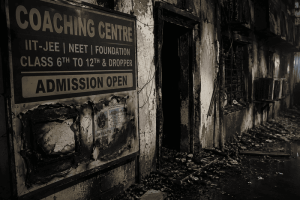
Nine people burned to death in a routine electrical fire in East Delhi's Vivek Vihar neighbourhood in May 2026. Weeks later, flats gutted in a blaze at Gaur Green Avenue in Indirapuram - a stone's throw from Greater Noida - reignited a question that keeps resurfacing every fire season in India's cities: what is a resident of an existing, older building actually supposed to do, right now, before the next short circuit becomes the next headline?
The uncomfortable answer from fire engineers, resident welfare associations and regulators is that the codes exist - but the buildings people already live in were mostly built before those codes did, and the burden of retrofitting them has fallen substantially on occupants and building managers rather than on any single enforcing authority.
The Retrofit Gap: Why Old Buildings Are Different
A significant majority of fire cases in Mumbai over the past three years share one recurring thread: electrical faults, overloaded systems, concealed fire spread and buildings that were simply not designed for the way they are used today. Srinivas Valluri, National President of the Fire and Security Association of India, has observed that the most serious fire safety gaps in operational buildings surface after occupancy begins, once compliance gradually gives way to complacency.
That distinction - compliance versus complacency - is the crux of the retrofit problem. A newly constructed apartment complex is inspected against the National Building Code (NBC) before occupants move in. But the wiring, the fire doors, the extinguishers and the evacuation signage inside an existing home rarely get revisited unless a resident, a facility manager or an RWA specifically demands it.
Suraj Chaphekar, Assistant Vice President of Architecture at AVIGHNA, has pointed out that redevelopment offers a clean slate for integrating façade fire performance and properly pressurised fire towers from the start - but the real test facing India's older housing stock is whether fire safety becomes a foundational design principle, rather than a bolt-on response after risk has already appeared.
Retrofitting is also structurally harder than building fresh. Older structures may lack essential systems such as sprinklers and detectors altogether, and because many were not designed to house modern fire-safety equipment, hidden voids, thick walls and fragile materials can complicate any installation. Ageing electrical wiring in particular often cannot support new fire-alarm systems or emergency lighting without upgrades of its own.
Why Electrical Systems Are the Single Biggest Threat
The data leaves little room for ambiguity about where the danger actually sits. Delhi Fire Service attributes more than 80 percent of fires in the capital to electrical faults, and a Mumbai Fire Brigade analysis attributes nearly three-quarters of its incidents to the same cause. Yet the National Crime Records Bureau's tally of 7,566 fire accidents and 7,435 deaths in 2022 is widely regarded as an undercount, since many electrical incidents get buried in a generic "other" category rather than being separately classified.
Two forces are converging to make this worse inside existing homes rather than better. First, demand: India recorded a peak electricity demand of 256 GW in April 2026 amid extreme heat, and the International Energy Agency estimates that the installed base of air conditioners nationally could rise from 93 million in 2024 to around 240 million by 2030. Air conditioners draw a surge of electricity at start-up that is six to eight times their normal running current, and in many Indian homes they share a circuit with other heavy appliances - a combination that pushes decades-old wiring toward overload.
Second, detection: standard circuit breakers protect against overloads but cannot detect the micro-arcing responsible for roughly four out of five electrical fires, and Arc-Fault Circuit Interrupters - devices that catch this hazardous sparking and are mandatory in the United States - remain essentially absent from Indian residential wiring codes. India also lacks the kind of mandatory periodic inspection regime, common in Japan and South Korea, that would re-examine a home's internal wiring every four to five years; a thirty-year-old house may go unaudited until the day it catches fire.
What Residents and RWAs Can Actually Do?
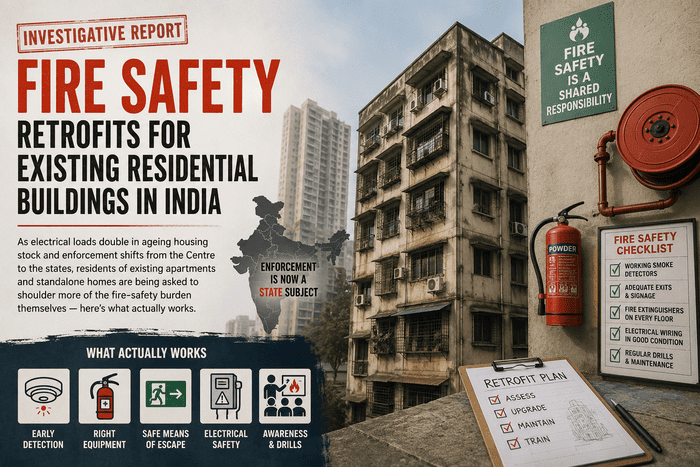
Fire engineers consulted across multiple reviews of India's retrofit landscape converge on a handful of interventions that do not require demolishing or redesigning a building - only auditing and upgrading what already exists.
Restore reliability to core systems first. Building owners and facility managers are advised to prioritise restoring reliability to core firefighting systems: confirming that pumps are operational, that dedicated fire water is actually available, that hydrants and sprinklers function, and that alarms are properly integrated with evacuation mechanisms. A functioning sprinkler system that nobody has tested in years offers false comfort.
Treat electrical load as a moving target, not a fixed spec. Any household adding a new air conditioner, an EV charger, or rooftop solar is changing the load profile of wiring that may have been sized for a very different era of appliance use. Analysts recommend that mandatory periodic audits be triggered specifically whenever a resident adds a major load like rooftop solar or an EV charger, rather than waiting for a fixed multi-year cycle.
Get exits and compartmentation right, not just alarms. Facility managers are also urged to keep exits clear, maintain functional emergency lighting, train first responders on-site, run regular mock drills, and commission periodic professional audits - all without disrupting day-to-day operations of the building. An alarm that sounds in a stairwell blocked by stored furniture buys residents nothing.
Know what the code actually requires for your building's height. Under the National Building Code, staircase enclosures require non-combustible internal walls with a minimum 120-minute fire-resistance rating, and electrical installations are meant to use flame-retardant wiring with high, medium and low-voltage cabling run through separate, fire-sealed shafts. Historically, NBC provisions required two staircase exits per floor for faster evacuation in a fire - a detail worth checking against your own building's layout, especially if it predates the code revision that introduced it.
Match extinguishers to the actual hazard. A basic society-level fire safety checklist recommends equipping different areas with the extinguisher type suited to what could actually burn there - water-based extinguishers for ordinary combustibles like wood, paper and fabric, for instance, rather than a one-size-fits-all approach. Kitchens, electrical rooms and parking areas each carry a different risk profile and need a different response tool within reach.
Push your RWA to verify paperwork, not just equipment. In Greater Noida specifically, this has already become an organised demand. The Federation of NOIDA Residents Welfare Associations has written to the Gautam Buddh Nagar Police Commissioner seeking a comprehensive review of fire safety compliance in high-rise residential and commercial buildings, including verification of Fire No Objection Certificates and action against illegal or unauthorised structural modifications. The federation has separately proposed regular mock drills and inspections of electrical systems, wiring networks and equipment installations, which it identifies as a leading cause of fire outbreaks in the region. A resident does not need to wait for a federation letter to ask their own society's management for the same verification.
A Regulatory Landscape in Transition
Complicating matters for residents trying to figure out what applies to their building is that the rulebook itself is changing. India is gradually moving from the National Building Code to a new National Building Construction Standard, a shift that hands more of the responsibility for fire-safety norms to state and local authorities, meaning approvals, inspections and enforcement will increasingly vary by city. Notably, the language of the rules themselves is softening in places - provisions that once used the mandatory "shall" are in some cases now worded as the advisory "should."
The NBC remains, technically, a recommendatory document; it becomes legally mandatory only once state governments incorporate it into their own local building bye-laws, a process nudged along by advisories from the Ministry of Home Affairs. That two-step chain - Centre recommends, state adopts, municipality enforces — is precisely where gaps tend to open in older buildings that were bye-law compliant at the time of construction but have never been re-certified since.
What's Next?
The regulatory direction of travel - more advisory language, more state discretion - makes it likely that the practical burden of fire safety in existing residential buildings will keep shifting toward RWAs, facility managers and individual residents rather than a uniform central mandate. Industry voices are pushing for India to build a national forensic fire-investigation capacity so that "short circuit" stops being a catch-all explanation and starts being root-cause data that can inform policy - but that infrastructure does not yet exist at scale.
Until it does, the fastest fire-safety upgrade available to most households isn't a new gadget - it's an honest, professional audit of wiring load, exits and extinguisher placement in the home they already occupy.
Conclusion
The fires in Vivek Vihar and Indirapuram were not caused by a missing building code - India already has one. They were symptoms of a retrofit gap: safety systems designed for the building as it was approved, operating years later inside a building whose electrical load, occupancy and physical condition have all quietly changed. Closing that gap in an existing home does not require rebuilding it. It requires an audit, an upgrade to the wiring that actually carries today's appliances, and a resident willing to ask their RWA the uncomfortable question of when the fire systems were last tested.